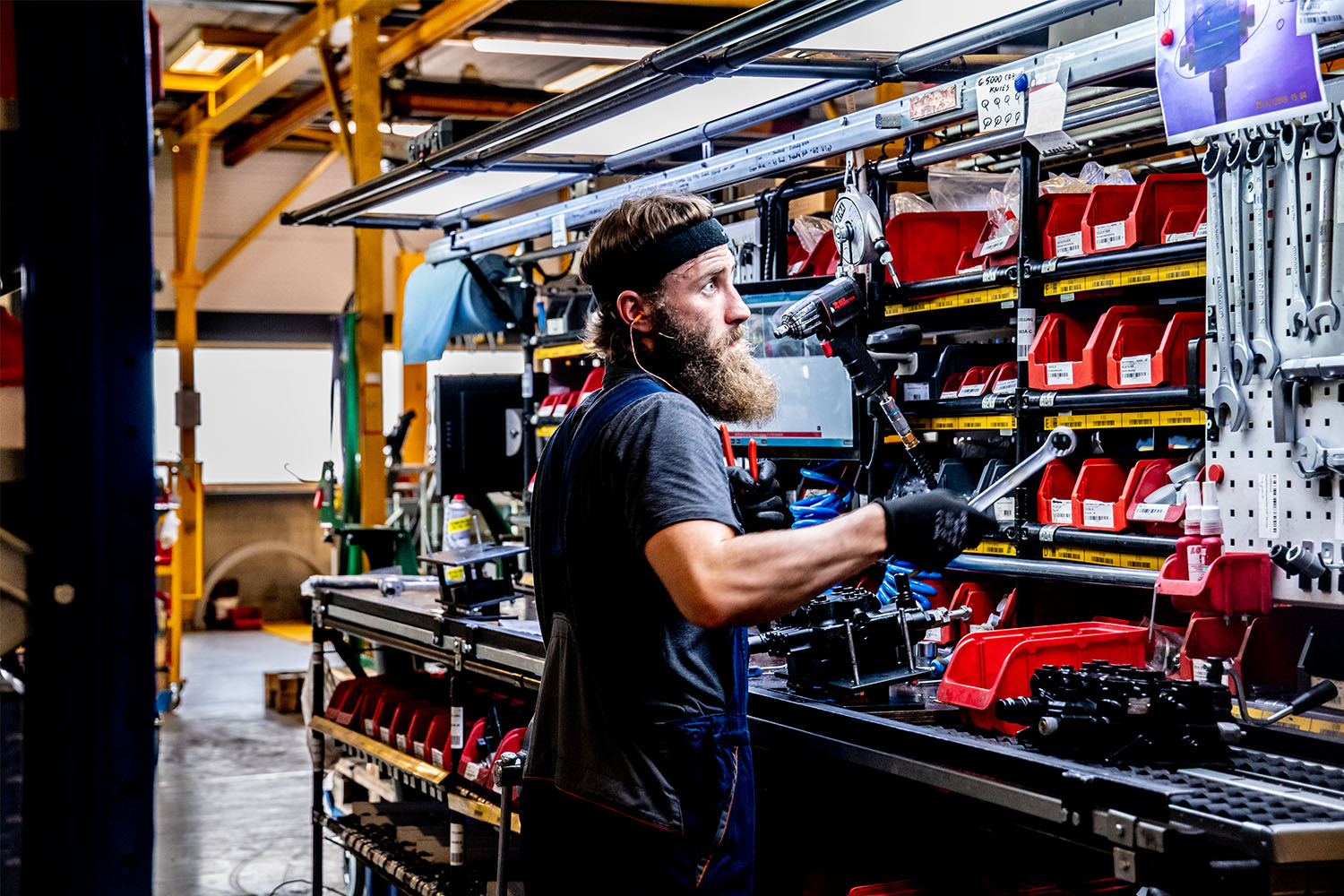
What is a mechanic?

In brief

As a Mechanic you will build installations, keep them in top condition and solve malfunctions. From mechanical to electrical and service: you ensure that everything keeps running. You often choose a specialism and grow within it step by step.

What does a Mechanic do?

You work on machines and installations: assembling, maintaining, finding and fixing malfunctions. You read schematics, replace parts, adjust and test. Sometimes you rebuild for a new functionality or product variant. You work independently, but easily interact with colleagues and suppliers. 

Typical tasks:

  • Schedule and perform maintenance and inspections

  • Analyze malfunctions, eliminate cause and test

  • Convert and tune installations for new runs
    Replacing parts and updating documentation

  • Working safely and suggesting improvements

What competencies should you have?

These are the qualities that make you excel in this role:

Technical understanding and Result-oriented
Solution-oriented, calm under pressure
Sense of responsibility and working safely
Collaboration and clear communication
Eager to learn; quickly pick up systems and processes
Process-based thinking and continuous improvement

What does a workday look like?

You start with the planning and safety check. Then you pick up work orders: a maintenance job, an acute malfunction, a conversion for afternoon production. In between, you order parts, record findings, and briefly consult with production or supplier. At the end: everything is running, breakdowns have been phased out, and the line is ready for the next shift.

Training and advancement

You can enter through MBO engineering or a BBL route. During your career you specialize in direction(s) such as mechanical, electrical, service, car, (company) car, breakdown or assembly. You can advance to all-round mechanic, technician or (lead) service mechanic.

Examples of training:

  • Mechanic Service & Maintenance Installation Technology (mbo)

  • All-round Mechanic / Mobile Equipment Mechanic (mbo)

  • Mechatronics / Mechanical / Electrical Engineering (mbo)

  • Continuation: technician (mbo-4) or college transfer

Salary

As a starter (21+) you will earn an average of €2,500 - €2,900 gross per month (approx. €14.40 - €18.00 per hour), depending on specialty and sector. With experience, breakdown services and consignation, this often grows towards €3,100 - €3,600+.

Diploma

A mbo diploma in mechatronics, mechanical engineering, electrical engineering or (service) maintenance fits perfectly. Through BBL you work and learn at the same time. In addition, VCA, NEN knowledge and manufacturer training are valuable.

Number of hours

Mostly full-time (36-40 hours per week). For service or breakdown shifts, you can make extra hours according to allowance schedule.

Working Hours

Depending on the company: day shift, 2/3 shifts or breakdown/consignment shifts. Irregularity usually results in surcharges.

Reviews we are proud of

Ready to build?

Mechanic

Fancy solving problems before they become problems? Put on your work boots - you'll keep the Netherlands running.

Apply immediately - arranged within 1 minute

Frequently Asked Questions

Should I choose one specialty right away?

Not necessarily. Many mechanics start broader and then choose a direction (e.g., electrical or service). Employers often help with training and certifications.+

Both. You tinker a lot, but you also record breakdowns, maintenance and parts. That info keeps the machinery reliable.


You stand and lift regularly, but work with tools. Safety, lifting technique and a tidy work area make it doable.

VCA, NEN-3140/1010-basis, hydraulics/pneumatics, manufacturer training and possibly driving licenses (in case of service) will give you an edge.

All-round/technician, breakdown engineer, field service technician, work planner, team leader or direction engineering (with additional training).