

The service is excellent. I requested a document and received an immediate response.
Not necessarily. In manufacturing, you learn many tasks by doing. For the more technical assembly positions, a mbo degree in engineering is helpful.
As Assembly worker In production, you're the one who puts together individual parts into a complete product. You work on the assembly line or production line and make sure everything is tiptop. Without you no final product!
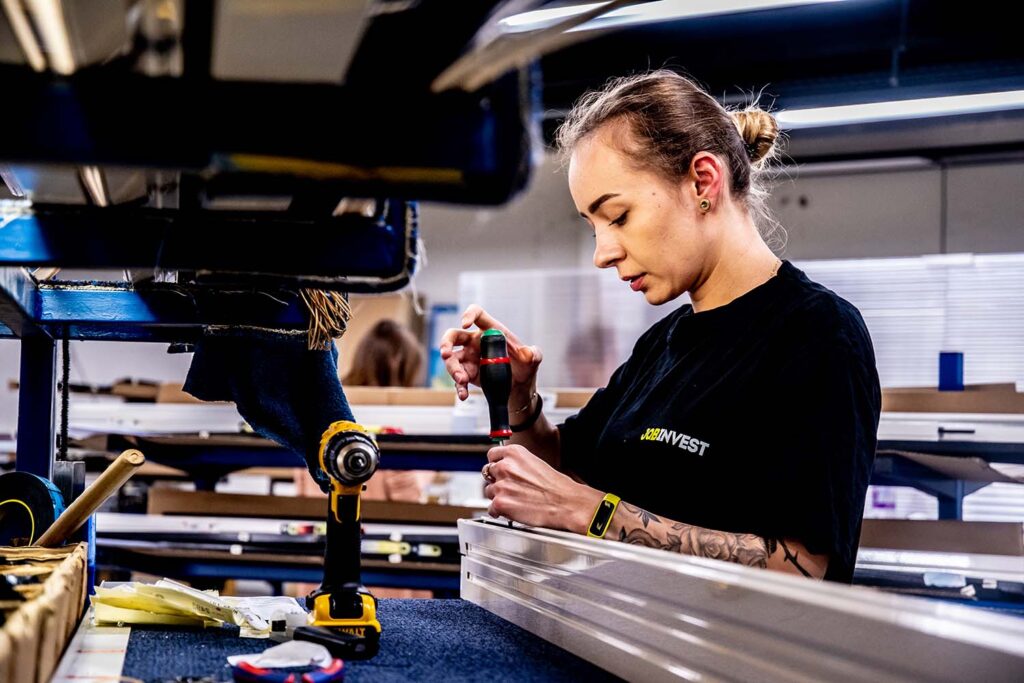
An Assembly worker performs final assembly. You ensure that parts come together to form a semi-finished or finished product and monitor quality along the way. Your duties may include:
So you are not only editing, but also checking and improving.
These are the qualities that make you excel in this role:
You start your day by reviewing work instructions and checking that all parts are present. Then you get to work assembling: from small semi-finished products to complete finished products. During the process you keep a sharp eye on quality. Do you see deviations? Then you correct them immediately or report them to your supervisor. At the end of the day you make sure that everything is left behind neatly and safely, ready for the next shift.
For a job as an Assembly Clerk, you usually don't need a long education, but you do need an affinity for engineering or manufacturing. You often learn the work in practice. Handy to have in your backpack:

The starting salary for an Assembly worker is around €14.40 gross per hour (legal minimum wage as of July 2025). In practice, you will usually earn between €2,200 and €2,600 gross per month, depending on experience, sector and shift premiums.

A specific degree is not always required, but an MBO degree in manufacturing, metal or engineering gives you an edge.

Most Assembly workers work full-time (36-40 hours per week). Sometimes part-time options are available.

You often work shifts (morning, afternoon, evening or night). Day shift positions also occur, depending on the employer.
2 months ago
The service is excellent. I requested a document and received an immediate response.
2 months ago
I had known Job Invest for a few years, but had never worked with them before. I am very satisfied with the whole experience, especially with Ms. Carmen 🤞
2 months ago
Very satisfied, very professional and friendly people. Highly recommended ✅🙂 ...
2 months ago
The recruiter, Kelly, was very professional and helpful. I thank her for her excellent work.
3 months ago
I recently started working with them and so far everything is great. The accommodation is excellent and the staff is even better.
3 months ago
The best agency! They found great work for me and they did it super fast. If there was a problem, it was solved the same day. We always had good contact. I can recommend them without hesitation👌.
Are you ready to transform loose parts into a top quality finished product? Take the step now to a job as an Assembly Worker and show what you can do.
Yes, we have received your application! We will contact you shortly by telephone or email.
We schedule an introductory meeting via Teams or at our office to get to know each other better.
We find out which job truly suits you and discuss the options together.
Once excited, you go for an interview with the employer to see if it's a complete fit.
Both enthusiastic? Then we will sign the contract and you will start at your new job!
Even after you start your new job, we stay involved. If you have questions or run into anything, you can always reach out to us.
No, often you just learn the trade on the shop floor. Experience with production or engineering does help you get started faster.
Not necessarily. In manufacturing, you learn many tasks by doing. For the more technical assembly positions, a mbo degree in engineering is helpful.
The work can be physical, as you often stand and sometimes have to lift. On the other hand, you work in a team and often have tools, such as lifting or hoisting equipment.
Yes, you can advance to positions such as Operator, Quality Assurance Officer or Team Leader. Many employers offer in-house training or courses.
Not always. At some companies you work day shift, but many manufacturing companies run 2- or 3-shifts. This often provides extra allowances.
 Dutch Dutch
 English
 Spanish
 Portuguese
 Polish Dutch Dutch English Spanish Portuguese Polish